

Producers Performing Service Work
Licensed producers may spend valuable time handling routine account requests that do not require their highest value expertise.
→
Insurance agencies grow when producers can spend more time selling, advising clients, and developing relationships. Repetitive service requests, manual renewal outreach, disconnected information, and inconsistent follow up may consume valuable producer and service capacity.
Licensed producers create value when they are selling, advising clients, strengthening relationships, and identifying responsible growth opportunities. Routine service work and disconnected processes may reduce productive sales capacity.


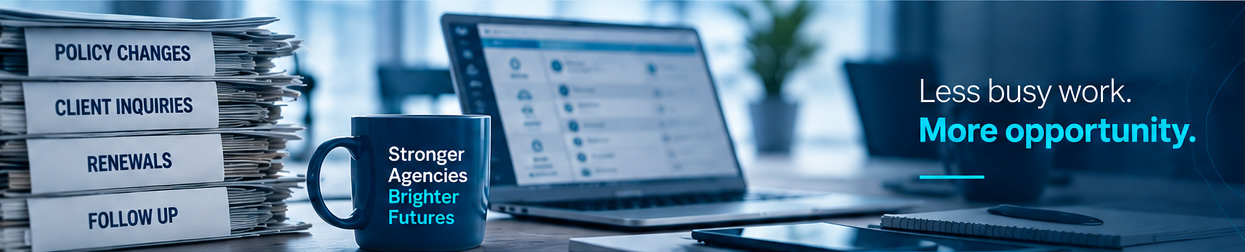
Licensed producers may spend valuable time handling routine account requests that do not require their highest value expertise.

Employees manually contact policyholders before renewal and repeatedly coordinate information.

Service employees may repeatedly handle billing, identification card, certificate, and routine account inquiries.

Follow up quality may vary by employee, workload, or location.

Insurance agencies hold personal and financial information that requires appropriate controls and oversight.

Customer information may be distributed across email, spreadsheets, agency systems, phone conversations, and individual knowledge.

Less time may be available for selling and advising clients.

Important renewal conversations may happen late or inconsistently.

Employees may spend more time finding information and coordinating service.

Client experience can become inconsistent.

Staffing pressure may increase as the book of business grows.

Operational and cybersecurity exposure may increase.


Routine communication and information collection can be automated while questions requiring licensed insurance advice are routed to the appropriate agency professional.



Policyholders should know their request has been received and what happens next.

Client service should not depend entirely on which employee receives the request.

Open requests should have clear ownership and a defined next action.

Leadership should understand where requests, renewals, and follow up activity may be stalling.
Disconnected information creates additional searching, duplicate communication, inconsistent follow up, and limited visibility. KeenPlex can help connect communications and workflow so information moves more consistently through the agency.









AI can support productivity, but agency leadership should understand where sensitive policyholder information is being used and what controls are appropriate.
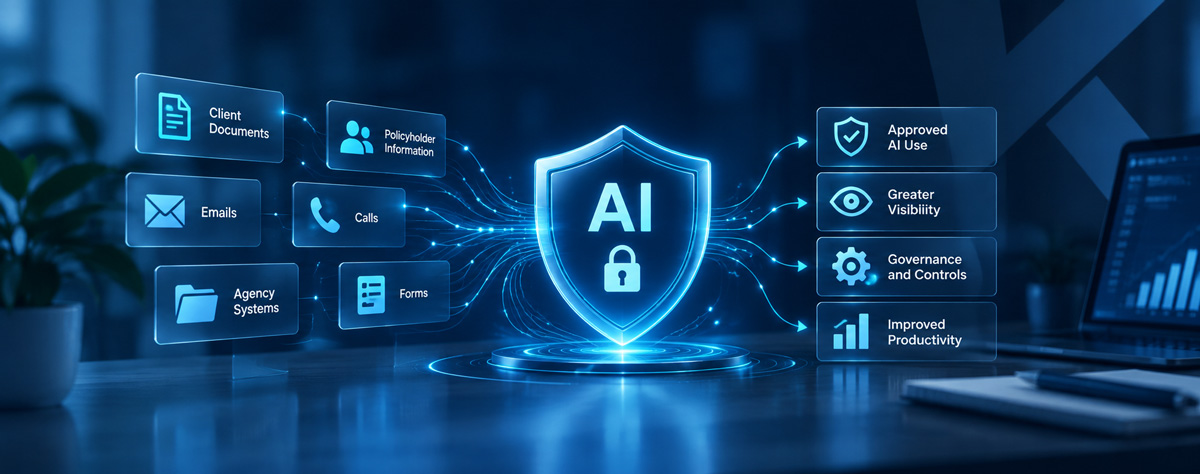

Understand which types of client information may enter AI workflows.

Define where AI can appropriately support agency work.

Improve leadership awareness of how employees use AI.
Apply policies and technical controls appropriate to agency workflows.
Apply appropriate controls to employee and administrative access.
Reduce exposure through one of the agency's most used communication channels.
Support consistent protection and visibility across devices used for agency work.
Align access to sensitive information with roles and business need.
Support continuity when systems or information become unavailable.
Attack Path Assurance can help examine whether an attacker could reach important business systems.

Clarify the outcome leadership owns.

Examine service, renewal, workflow, systems, and risk.

Connect the condition to capacity, service, growth, or resilience.

Connect communication, workflow, technology, and security.

Prioritize evidence and operating value.
Support routine inquiries, request routing, information collection, reminders, and employee escalation.
Make service processes more consistent and reduce dependence on employee memory.
Reduce duplicate work and improve workflow visibility across relevant systems.
Support resilience and protection of sensitive client information.
Improve visibility and governance around employee AI use involving policyholder information.
Baseline data is required before a meaningful improvement hypothesis can be created.
Does the operating model support greater producer sales capacity?
Are relationships supported through more consistent service and renewal processes?
Is producer capacity protected for selling and advisory work?
Begin by examining how customer requests, renewal activity, information, follow up, and producer involvement move through the agency before deciding which technology should change.
Request a Revenue Capture Assessment


How incoming requests are received and routed.
Where licensed producers become involved in repetitive service work.
How policyholder information and renewal communication move through the agency.
Where requests or opportunities may stall.
Where information is fragmented across tools.
What data can support a conservative opportunity hypothesis.
For manual renewals, repetitive communication, document collection, reminders, and service handoffs.
For sensitive client information, identity, email, devices, access controls, and recoverability.
For employee AI use, policyholder information, governance, controls, training, and approved use cases.
This illustrative scenario is not a customer result.
Growing independent agency with service activity arriving through several channels.
Protect producer selling time and improve renewal consistency.
Manual routing, scattered information, and follow up dependent on memory.
Connected communication and workflow may reduce repetitive coordination and improve visibility.
Revenue Capture Assessment.
Technology can organize routine communication, information collection, routing, reminders, and visibility so producers can focus more time on selling, advice, and relationship development. A Revenue Capture Assessment is the recommended starting point.
Routine acknowledgments, information collection, document requests, reminders, and routing may be appropriate. Questions requiring licensed advice should move to the appropriate agency professional.
The workflow should identify the request type and route questions requiring advice or a licensed decision to an authorized professional with the relevant context attached.
Renewal reminders, contact sequences, information confirmation, document collection, and employee notifications can be coordinated while licensed professionals retain responsibility for advice and decisions.
KeenPlex can evaluate available integration paths and workflow constraints around the systems already in use. The appropriate approach depends on the system, access, and business objective.
Define clear ownership, next actions, reminders, escalation paths, and leadership visibility. Workflow Automation can help make those steps more consistent.
Begin with identity, email, device, access, backup, and recovery controls, then align those controls with how information moves through daily agency workflows.
Leadership should understand what information may enter AI tools, define approved uses, establish governance, and apply appropriate technical controls and training.
Workflow Automation coordinates defined process steps. An AI Employee can support conversation, classification, information collection, and routing within approved boundaries. Both should connect to a clear operating objective.
Begin with the Revenue Capture Assessment when the main question is producer capacity, service response, renewal activity, or missed opportunity. Use a focused workflow, cybersecurity, or AI readiness assessment when that constraint is already clear.
KeenPlex Technologies can help identify where service requests, renewals, communication, disconnected information, or technology risk may be limiting performance before recommending the appropriate solution.